 By Emma Hartley, Food Editor
Reviewed & updated September 2026
As an Amazon Associate, The Nourish Kitchen earns from qualifying purchases. We only recommend products we would suggest to a friend — see our Affiliate Disclosure.
Air fryers earned their hype for good reason: they make crispy food fast, with little to no oil, and almost no preheating. If you're new to them and staring at a wall of models wondering which to buy, this guide cuts through the noise. We'll cover the types, the size you actually need, and the features worth paying for — so you choose a machine you'll use, not one that collects dust on the counter (the fate of a surprising number of air fryers).
Think of an air fryer as a compact, turbocharged convection oven: a fan blasts hot air around the food for that fried-like crispness, minus the oil bath.
 What you’ll find insideCurated by Emma · 8 min read
Basket vs. oven-style: which type?
- Basket air fryers are the classic design — a pull-out drawer that's compact, quick, and easy to clean. Ideal for one or two people and the most beginner-friendly.
- Oven-style air fryers have a door, racks, and more capacity, often doubling as a toaster oven. Better for families or anyone wanting to cook more at once, though they take up more counter space.
What size do you need?
Capacity is the most common regret, so size up if you're unsure:
- 2–3 quarts — single person or small portions; tight for a full meal.
- 4–5 quarts — the sweet spot for couples and small families.
- 6+ quarts — families, or anyone who wants to cook a whole chicken or large batches.
The size mistake almost everyone makes
If there's one thing buyers regret, it's buying too small — so let me be specific about why. Air fryers cook by circulating hot air, which means food has to sit in a single, uncrowded layer to crisp properly. Pile it up and the pieces steam instead of crisping, and you end up cooking in multiple batches, which is slow and annoying. So the usable capacity is much smaller than the quoted number suggests: a "4-quart" basket comfortably crisps food for one or two people, not four. As a rule, picture how much food you can lay flat in a single layer, not how much you can cram in. Most households are happiest going one size up from what they first assume — a 5- to 6-quart for a couple who entertains, a 6-quart-plus for a family. The extra counter space it takes is almost always worth not cooking dinner in three shifts.
Our picks
Below are the types worth knowing, who each suits, and where each falls down. We have not tested individual units — these are the categories that keep proving themselves for home cooks.
| Category | Our pick | Best for |
|---|---|---|
| 🏆 Best overall | A 5 to 6 quart basket air fryer | Households of two to four |
| 👥 Best for a family | A dual-basket or 8 quart-plus | Four or more, or anyone cooking two things at once |
| 🍞 Best for versatility | An oven-style air fryer | Small kitchens replacing two appliances with one |
| 🧍 Best for one or two | A compact 2 to 3 quart | Singles, couples, dorms and offices |
| 💸 Best budget | A basic single-basket model | Finding out whether you will actually use one |
🏆 Best overall: A 5 to 6 quart basket air fryer
This is the size that fits most kitchens and most dinners. Big enough for four chicken thighs in a single layer, small enough that you will not resent leaving it on the counter.
- Best for: Households of two to four.
- Pros: Fits a real dinner in one layer, heats fast, easy to clean.
- Cons: Still needs counter space you may not have.
👥 Best for a family: A dual-basket or 8 quart-plus
Two baskets let you cook the protein and the potatoes at different temperatures and have them finish together. That is the feature people actually use, and it is worth the step up.
- Best for: Four or more, or anyone cooking two things at once.
- Pros: Two temperatures at once, genuinely large capacity.
- Cons: Big footprint, and heavy to move.
🍞 Best for versatility: An oven-style air fryer
Racks instead of a basket means it doubles as a toaster oven and a small second oven. You trade a little crisping for a lot more usefulness.
- Best for: Small kitchens replacing two appliances with one.
- Pros: Toasts, bakes, reheats, fits a small tray.
- Cons: Crisps slightly less well than a basket.
🧍 Best for one or two: A compact 2 to 3 quart
If you are cooking for one, a large basket just means longer preheats and more washing up. Small is genuinely better here, not a compromise.
- Best for: Singles, couples, dorms and offices.
- Pros: Fast, cheap, tucks away.
- Cons: One portion at a time, and it shows.
💸 Best budget: A basic single-basket model
The cheap ones do the same job with fewer presets and a dial instead of a screen. Air frying is hot air and a fan — the fundamentals are not expensive.
- Best for: Finding out whether you will actually use one.
- Pros: Very affordable, does the core job.
- Cons: Fewer presets, noisier, shorter expected life.
Features worth having
You don't need every bell and whistle, but a few make life easier: simple, readable controls (dials are foolproof; digital presets are convenient), a dishwasher-safe nonstick basket for easy cleanup, a wide temperature range (up to around 400°F / 205°C), and a shake reminder for even cooking. Skip gimmicky presets you'll never use — manual time and temperature control is all you really need.
Getting started with your air fryer
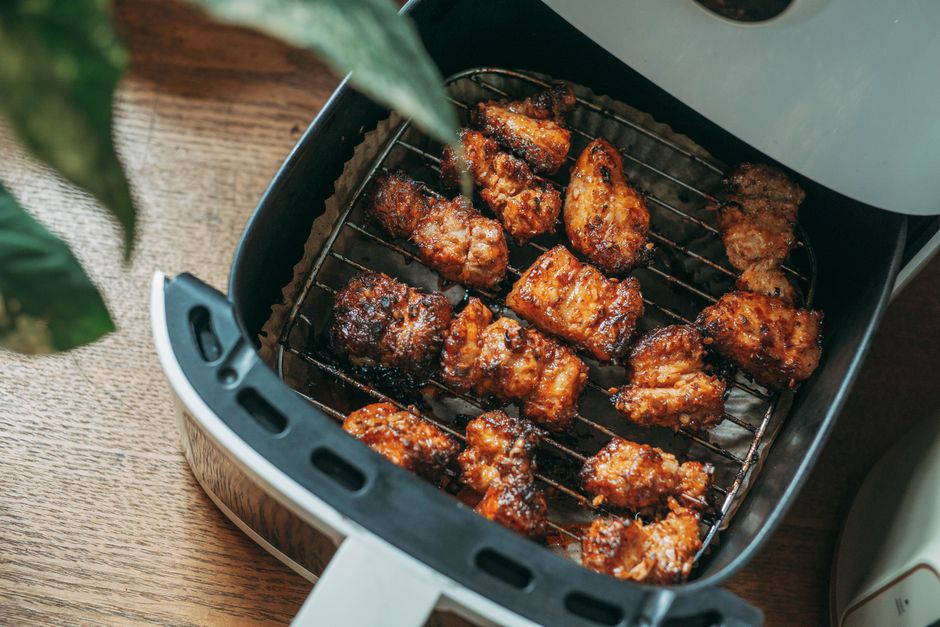
A few habits set you up for success: don't overcrowd the basket (air needs to circulate for crispness — this is the number-one beginner mistake), shake or flip halfway through, lightly spritz foods with oil for the best browning, and preheat for a couple of minutes when a recipe calls for it. Start with easy wins like frozen fries, roasted vegetables, chicken wings, and salmon to build confidence before tackling anything fussier.
Frequently asked questions
Is an air fryer worth it for beginners? Yes — it's forgiving, fast, and great for crispy results with little oil. It's one of the easiest appliances to learn.
What size should a first-time buyer get? A 4–5 quart basket model suits most households; size up to 6 quarts or more for families, since food must sit in a single layer to crisp.
Does food really taste fried? It gets crispy and golden with far less oil, though very batter-heavy fried foods won't be identical to deep-frying. For most everyday foods, the results are excellent.
Why isn't my air fryer food getting crispy? The basket is too crowded. Food has to sit in a single, uncrowded layer so the hot air can circulate — cook in batches if needed, and shake or flip halfway through.
Basket or oven-style air fryer for a beginner? A basket model is simpler, quicker to heat, easier to clean, and takes less space — the most beginner-friendly choice. Choose oven-style only if you need larger capacity or want it to double as a toaster oven.
Read next
Related articles
- 12 Useful Kitchen Gadgets Under $25
- Easy Meal Prep for Busy Weeks (Beginner’s Guide)
- How to Store Fresh Herbs So They Last
- How to Cook Perfect Rice Every Time
- Best Nonstick Pans for Everyday Cooking
- How to Choose the Best Chef’s Knife Under $50
From our test kitchen
The beginner mistake is overcrowding the basket. Air fryers crisp by circulating air, so a packed basket just steams — cook in batches and leave space, and it’s still faster than the oven.
Further reading & trusted sources
Emma thinks a recipe has failed if it needs a long backstory before the ingredients — so hers get straight to the point, with the small technique notes that actually change how a dish turns out. She leads The Nourish Kitchen’s recipes and food guides, writing each one to work in a real, busy kitchen rather than a photo studio. AI tools help with research and drafting, and a human checks every recipe for clarity and food safety before it publishes. Nutrition figures are honest estimates, never guarantees.